

African and Caribbean entrepreneurs have been building businesses in Britain for more than 250 years. The modern story begins with the Windrush generation, who were largely shut out of bank lending and built shops, salons, record labels and food wholesalers out of their own pooled savings instead. Those businesses became the infrastructure of whole communities.
This Black History Month, the theme is Honouring Our Communities, recognising people whose contribution is part of everyday life but too often goes unseen. Few groups fit that description better than the shopkeepers, hairdressers, builders, caterers, nurses-turned-care-home-owners and software founders who have quietly built businesses in British towns for three generations.
At Tax Care Accountants we work with a lot of them. So rather than post a generic tribute, we wanted to set out the actual history, the dates, the names, the numbers, and then introduce some of the businesses we are proud to have on our books.
Black business in Britain did not start in 1948
Black-owned businesses existed in Britain long before the Windrush generation arrived. The three below are among the best documented, each traceable to a museum, county archive or local authority record rather than to repetition.
Ignatius Sancho, grocer, Westminster, 1774

In 1774, Ignatius Sancho and his wife Ann opened a grocery shop in Westminster, a short walk from Parliament. They sold tea, sugar and tobacco. Because he owned a shop, Sancho met the property qualification to vote, and became one of the first Black people known to have voted in Britain.
The shop doubled as a meeting place for actors, writers and abolitionists. When he died, he became the first Black Briton to be given an obituary in a British newspaper. The London Museum puts the Black population of Britain at around 15,000 by the 1780s, most of them in London.
Cesar Picton, coal merchant, Kingston upon Thames, 1788
Cesar Picton was born in Senegal in 1755, into a Muslim family, and brought to Britain as a small boy in 1761, handed to Sir John Philipps by a sea captain and recorded in Philipps’s own writing as a gift, alongside a parakeet and a duck. He was raised and educated at Picton Castle in Pembrokeshire. Surrey History Centre is careful on the point that is usually got wrong: he never became a servant.
When Lady Philipps died he was about 33, and she left him £100. He rented a house in Kingston upon Thames, bought it outright in 1788, and took the surname Picton from the castle where he grew up. Sir John had connections in the coal trade, which almost certainly shaped what Cesar chose to sell.
In 1816 he bought a large cottage in Thames Ditton for £400, four times his entire inheritance, and the clearest evidence of how well the business had done. He died in 1836, aged 81, described in another man’s will as a gentleman.

George Africanus, employment agency, Nottingham, 1793
George Africanus was born in Sierra Leone around 1763 and brought to England as an enslaved child in 1766. With his wife Esther Shaw he founded Africanus’ Register of Servants, an employment agency matching staff to households.
The family ran it for more than seventy years, according to Nottingham City Museums. As a freeholder Africanus could vote, and he served as a special constable in the city’s Watch.

1948–1970s: the Windrush generation starts trading
The Windrush generation arrived to fill post-war labour shortages in the NHS, on the buses and in the factories. Many then started businesses because employment alone could not get them housing, credit or advancement. The first wave of Caribbean enterprise served a market British retail was ignoring: food, hair products, records, travel and remittances.
The pattern repeated in every city with a Caribbean population, Brixton and Hackney in London, Handsworth in Birmingham, Moss Side in Manchester, St Pauls in Bristol, Chapeltown in Leeds. A shop selling yam, green banana, saltfish and hard-dough bread. A front-room barber. A record shop importing ska and later reggae. A minicab firm, because the licensed trade was closed off.

The pardner hand: how Black businesses financed themselves when the banks would not
The pardner hand is a community savings scheme in which a group of people each pay in a fixed amount at a fixed interval and take turns receiving the whole pot. Ten people put in £20 a week; each week, one of them takes the £200.
There was no bank interest and no formal credit assessment. What held it together was an appointed organiser, trust, and the reputational cost of failing to pay in, defaulting meant facing your neighbours, your church and the man you sat next to on the night shift.
The Bank of England Museum, which exhibited the scheme with Museumand, the National Caribbean Heritage Museum, describes it as a rotating savings and credit association. It became important to Caribbean people in Britain who were refused banking services, or struggled to get them, often because they had no UK credit history. The model came from West Africa, where it is known as esusu or susu, and travelled to the Caribbean and then to Britain.
Museumand records what it was used for: funding businesses and buying homes. A deposit on a shop. A first van. Three months of stock. The dryers and basins for a salon. A generation of British businesses was capitalised, pound by pound, out of wage packets, and pardner hands are still in use today.
The instinct underneath them, fund it yourself, owe nothing to an institution that never wanted you, has outlived the discrimination that created it. We come back to that below, because it has a cost.
The shop was never just a shop
Here is what gets lost when this history is told as a run of founder stories. These businesses were the infrastructure of a community the state was not serving.
The shelves were the least of it. There was a noticeboard by the door with rooms to let, because plenty of landlords would not advertise to you. There was someone behind the counter who knew which factory was hiring and which foreman was decent. There was credit until Friday, written in a notebook, for a family having a hard month. Someone would take a message, a parcel, or an envelope of money, back home.
The barbershop and the hair salon did the same job and more. An hour in the chair was an hour of news, argument, job leads, help with a letter from the council, and one of the few places in the week where a man could be entirely himself. Tony Wade’s account of the Dyke & Dryden shops makes the point directly: they became social outlets as much as retail ones.
They also employed people nobody else would. A young man with no references. A woman with children and no childcare. Someone newly arrived whose qualifications Britain refused to recognise. For people locked out of the formal labour market, these shops often were the labour market.
What the community built with it
If you want one example of how business, culture and community were a single thing, take the winter of 1958.
That September, racist attacks in Notting Hill escalated into days of violence. Claudia Jones, a Trinidadian activist who had founded the West Indian Gazette, Britain’s first major Black newspaper, in Brixton earlier that year, said the community needed something to get the taste of Notting Hill out of its mouth.
So on 30 January 1959, sponsored by the Gazette, a Caribbean carnival was held indoors at St Pancras Town Hall. The BBC televised part of it. English Heritage records it as the event widely credited with bringing Caribbean carnival to London, and the forerunner of the Notting Hill Carnival. It began as an event put on by a newspaper, paid for by advertising from Black-owned shops.
The same pattern runs through much of what the community built in these decades:
- Supplementary schools. Caribbean parents found their children were being placed in schools for the “educationally subnormal” in disproportionate numbers. In 1969, John La Rose, the New Beacon Books founder, established the George Padmore Supplementary School, one of the first of its kind. The association he co-founded went on to publish Bernard Coard’s How the West Indian Child is Made Educationally Sub-normal in the British School System in 1971, a book that forced a national argument. A bookshop seeded a schooling movement.
- Churches. Turned away from existing congregations, Caribbean and later African Christians founded their own. For some founders, those churches provided early customers, staff referrals and introductions when nothing else would.
- Sound systems and music. Front-room systems in Brixton, Handsworth and Moss Side fed record shops, then labels, then a share of the British music industry.
- Archives and institutions. The Black Cultural Archives in Brixton, the George Padmore Institute above New Beacon Books, the Afro Hair and Beauty Show. Community institutions founded and kept alive by people who ran businesses, because nobody else was going to fund them.
These were not people who happened to be Black and happened to run shops. They were building the thing that held a community together while the country worked out what it thought of them.
1980s–1990s: from corner shop to whole sectors
In the 1980s and 1990s, Black British business moved from serving a community to building industries. Hair and beauty, music, publishing, media, food manufacturing and events developed Black-owned supply chains, manufacturers, distributors, retailers and trade shows, rather than single shops. Several of those sectors now reach customers well beyond the Black community.
Media followed the same logic. In 1982, Val McCalla founded The Voice, and Black-owned businesses finally had a national place to advertise to their own customers.
This was also the period when the second generation entered the professions. Children of the Windrush arrivals qualified as accountants, solicitors, surveyors and doctors, then set up their own practices. That matters more than it is usually credited: it is the point at which the community started producing its own professional advisers, rather than depending on firms that did not understand it.
It was not a smooth decade. The uprisings in Brixton, Handsworth, Toxteth and Tottenham destroyed businesses in exactly the areas where Black enterprise was concentrated, and many firms rebuilt without insurance or credit behind them.
1990s–2000s: the African wave
From the 1990s, migration from West and East Africa reshaped Black British enterprise. Nigerian, Ghanaian, Somali and Zimbabwean communities started businesses in different sectors from the Caribbean wave: pharmacy, logistics, recruitment, IT services, import-export, money transfer and care.
The map redrew itself. Peckham, Woolwich, Barking, Dalston and Croydon in London; Erdington, Aston and Handsworth in Birmingham; Cheetham Hill and Moss Side in Manchester; Leicester, Cardiff, Sheffield. High streets rebuilt around food shops, fabric and tailoring, braiding salons, phone shops and remittance counters.
Care is a significant part of this story. Many African migrants came into the NHS and social care as nurses and carers, learned the sector from the inside, and went on to found their own domiciliary agencies, supported-living services and care homes. It is one of the least-told business stories in the country, and one of the hardest to size, because nobody collects the data.
The founders worth naming
Black business history in Britain has names, dates and addresses attached to it. These are documented businesses, not anecdotes.
Len Dyke, Dudley Dryden and Tony Wade, Dyke & Dryden, Tottenham, 1965

In May 1965, Len Dyke and Dudley Dryden opened a small shop at 126 West Green Road, selling records and products for Black skin and hair. Tony Wade, born in Montserrat, joined as the third partner. By 1973 they had dropped records entirely to concentrate on hair and beauty, moving from reselling American products into manufacturing their own, the Super Curl and Natural Beauty ranges, and launching the annual Afro Hair and Beauty Show.
Two details are worth holding onto. Haringey Council’s Windrush archive records that the founders used their own money to set up the company, because the High Street banks did not support Black businesses. And that by 1986 the company had numerous branches and an annual turnover of £5 million. Bruce Castle Museum, which holds the company’s archive, describes it as Britain’s first Black multi-million-pound business.
There is an honest ending, too. In 1987 the founders sold most of their shares to Soft Sheen, an American company, as competition in the global Black hair and beauty market intensified. Building an industry and keeping ownership of it turned out to be two different problems.
George Saunders, tailor, Hurst Street, Birmingham
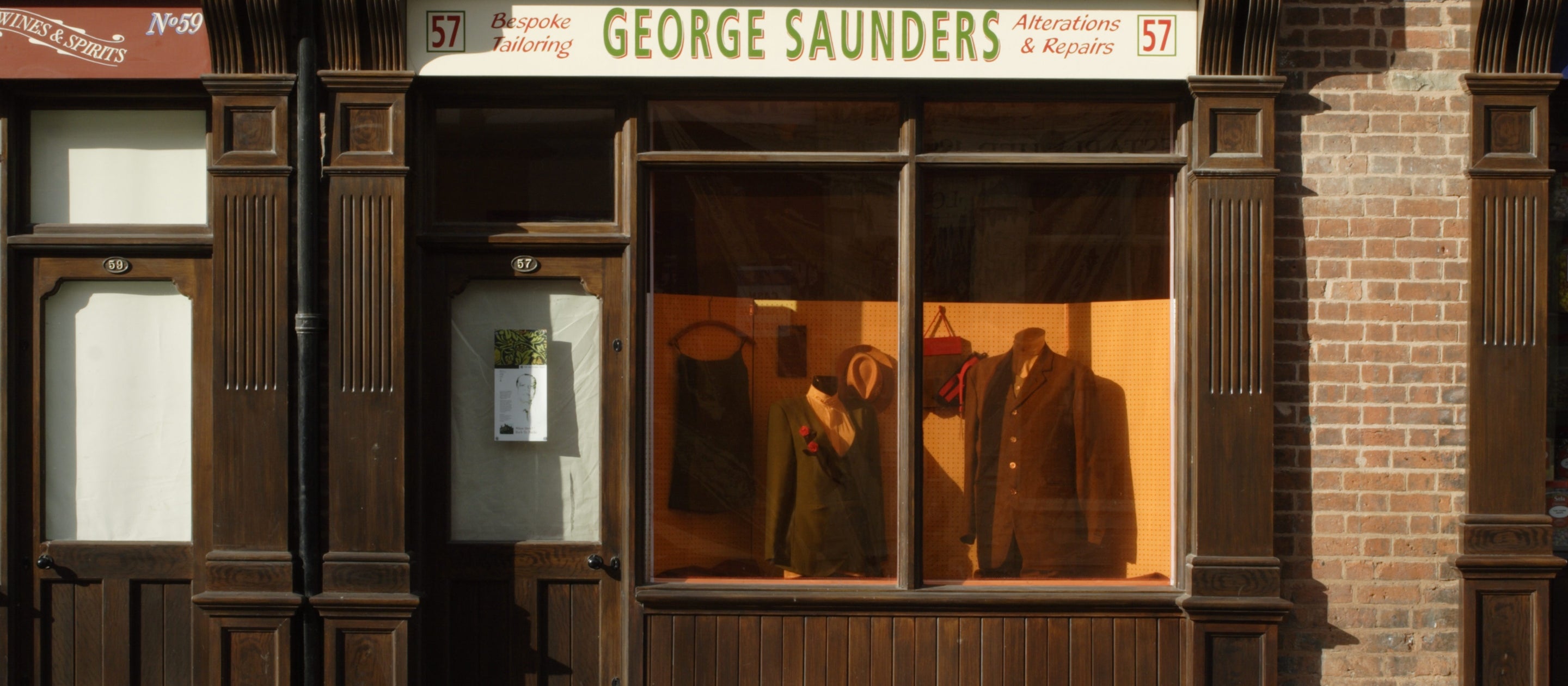
George Saunders arrived from St Kitts in 1958. He was a trained tailor and could not get work as one. So he took a workshop at Court 15 on Hurst Street and tailored for himself, word of mouth, one suit at a time, until his name was the reason people came through the door.
The workshop is still there. The National Trust preserves it as part of the Birmingham Back to Backs, the last surviving court of back-to-back houses in the city. It is a few minutes from our Birmingham office, which is a fact we think about more often than you might expect.
John La Rose and Sarah White, New Beacon Books, Finsbury Park, 1966

The UK’s first Black publisher, specialist bookshop and international book distributor, founded on Stroud Green Road. If you wanted Caribbean or African writing in this country, this is where it came from. La Rose also founded the Caribbean Artists’ Movement and was a founder member of the Black Parents’ Movement.
Arif Ali, greengrocer, then Hansib Publications, Tottenham, 1966
Ali opened a greengrocer stocking Caribbean produce that customers travelled across London to reach, then built Hansib into one of Britain’s longest-running Black and Asian publishing houses, the house that later published Tony Wade’s account of Dyke & Dryden, How They Made a Million.
Margaret Busby, Allison & Busby, London, 1967
Born in Ghana, Busby co-founded the publishing house in her twenties, becoming Britain’s first Black woman book publisher and its youngest. She published writers mainstream houses would not touch.
What connects all of them, across two centuries, is the same mechanism: a market the established business world was ignoring, served by someone from inside the community, financed without institutional credit.
Black-owned business in the UK today: what the numbers say
The honest answer is that the evidence is patchier than it should be, and that is part of the problem.
- £25bn to £74bn a year. The estimated annual gross value added by ethnic minority businesses in the UK. The range is that wide because the underlying data is poor.
- More than three million people. How many are employed by those businesses.
- 9.9% against 6.4%. Early-stage entrepreneurial activity among people from ethnic minority backgrounds, compared with the UK population as a whole. The appetite to start something is there.
- 38 businesses. 0.24%. Black-owned businesses that received UK venture capital across the decade from 2009 to 2019, and their share of all the capital analysed.
- 0.02%. The share that went to Black female founders over the same ten years. Ten businesses.
- 39%. Black respondents who said they had stopped pursuing a business idea because of barriers to finance.
- 13%. Black-owned businesses who said they looked to banks for financial support, in a 2021 survey of more than 800 participants for the Black Business Network and Lloyds Bank.
- Three-quarters against eight in ten. Black male-owned firms reporting a profit in 2019, compared with white-owned firms.
Sources: the Social Market Foundation’s 2021 review for the GVA, employment, entrepreneurial activity and profitability figures; Extend Ventures via the Black Equity Organisation for the venture capital and abandoned-idea figures; and Lloyds Banking Group for the banking survey.
Two things to be careful about, because plenty of articles are not. The widely quoted £25 billion figure is the bottom of a range, and it covers all ethnic minority businesses, not Black-owned firms alone, a category the Social Market Foundation itself warns is too broad to be useful. And the venture capital numbers describe 2009 to 2019. They are a decade-long finding, not a snapshot of today.
The barriers that have not gone away
The barriers today are less about outright refusal and more about access: to capital, to procurement contracts, to professional advice and to networks.
Capital. Rejection, or the expectation of it, still shapes behaviour. Self-funding keeps control, but it caps growth and leaves firms thinly capitalised when trading gets hard.
Procurement. Large corporate and public-sector contracts carry requirements, turnover thresholds, filed accounts going back several years, certifications, insurance levels, that disproportionately exclude younger and smaller firms. Getting procurement-ready is usually an accounting and compliance problem rather than a capability problem.
Professional advice. This is the one we see most directly. A business built on self-reliance often stays self-reliant for too long, running on a spreadsheet and a personal current account well past the point where that is sensible.
Data and recognition. Black-owned business is under-measured in official statistics, which weakens the case for targeted support and makes these firms harder to find for the buyers and lenders actively looking for them.
What a fundable, contract-ready business looks like
The difference between a business that gets finance or wins contracts and one that does not is usually bookkeeping, not ambition. Public filings get reviewed during due diligence, lenders read management figures, and a business with clean, current books simply looks safer than an identical business with messy ones.
- A separate business account from day one. Mixed personal and business banking is the single most common reason a set of books takes three times as long to prepare and still looks unreliable.
- Current books, not annual ones. Monthly bookkeeping tells you your margin before the year ends rather than nine months after it. It is also increasingly a legal requirement: Making Tax Digital for Income Tax applies to sole traders and landlords with qualifying income above £50,000 from April 2026, with lower thresholds phased in after that. Check where you sit.
- The right structure for your stage. Sole trader or limited company changes your tax, your liability, and sometimes whether a larger customer can contract with you at all, some procurement frameworks require or strongly prefer limited-company suppliers.
- Everything filed on time. Companies House records are public, and they are looked at.
- Accounts presented properly. Two businesses with identical trade can file very different-looking accounts. How you treat director’s loans, stock, fixed assets and accruals is the difference between a set of accounts that supports a finance application and one that invites questions.
- Claiming what you are entitled to. Capital allowances, the Employment Allowance, home-office and vehicle costs, R&D relief where it genuinely applies. Self-funded businesses routinely overpay tax because nobody told them what was claimable.
None of that is specific to Black-owned businesses. It belongs in this article because a community pushed into self-financing is also a community where good advice tends to arrive late, and that gap has a price.

My Letting Agent Pays Me After Deductions: What Rental Income Should I Record?
Your letting agent pays you after fees, so the bank deposit is not your rental income. Learn how to record gross rent, deductions and reconcile each statement.

Property Repairs vs Improvements: What Can Landlords Claim Against Rental Income?
Repairs are deductible against rental income. Improvements are capital. See how HMRC treats kitchens, bathrooms, boilers, decorating and extensions.

Black History Month: Shop Counter to £5 Million Empire
From a Tottenham Shop Counter to £5 Million: The Story

Client of the Month: FITN LDN Limited
This month, we’re celebrating them as our Client of the Month because they’ve taken that simple idea and turned it into something women all over the world genuinely rely on.

Left Your Job Partway Through the Year? You May Be Due a Tax Refund
Stopped work partway through the tax year? Find out how to check whether you have overpaid Income Tax and how to claim it back with a P50.

Cannot Pay Your Self Assessment Tax Bill? HMRC Time to Pay
Cannot pay your Self Assessment tax bill? How HMRC Time to Pay works, who can apply online, what it costs in interest, and what happens if you miss a payment.