
Every self-employed person faces the same question sooner or later: what is my actual tax bill going to be?
It is a reasonable thing to want to know, and it is harder than it should be to find a straight answer. HMRC’s own guidance is accurate but not designed for speed. Most online articles talk around the numbers without giving you yours.
That is what this calculator is for. Put in your turnover, deduct your business expenses and any pension contributions, and within a few seconds you will see your estimated Income Tax, Class 4 National Insurance, and take-home figure — broken down clearly.
What tax do self-employed people actually pay?
When you work for yourself, two things come out of your profits each year: Income Tax and Class 4 National Insurance. Both are calculated on your profit — your turnover minus your allowable business expenses — and both are paid through your Self Assessment tax return once a year.
That is the key difference from employment. No employer deducts anything on your behalf. You earn the money, you work out what you owe, you set it aside, and you pay it in January. This calculator handles the working-out part.
How to use the calculator
Step 1 — Enter your annual turnover. This is your total self-employment income before any deductions.
Step 2 — Add your allowable business expenses. Tax is calculated on profit, not turnover. Every legitimate expense you can claim reduces the profit figure, which reduces your bill.
Step 3 — Include pension contributions. Contributions to a personal pension reduce your taxable income and can bring you out of a higher rate band.
Step 4 — Add any other taxable income. If you also have employment income, rental income or anything else that goes on your return, include it here.
Step 5 — Check your tax code. For most people it will be 1257L. If yours is different, update it in the calculator.
Once everything is in, the results show your estimated Income Tax by band, your Class 4 NI, your total liability, and your take-home pay.
Example: Freelancer Earning £50,000
First, we calculate the taxable income: £50,000 − £12,570 = £37,430. As a result, this is still entirely within the basic-rate band (which runs up to £50,270), so consequently no higher-rate tax kicks in here. However, you’re right on the edge — earn another £271 and you’d start paying 40%.
Income Tax Breakdown
| Personal Allowance (first £12,570 at 0%) | £0.00 |
| Basic rate — £37,430 × 20% | £7,486.00 |
| Higher rate (40%) | £0.00 |
| Additional rate (45%) | £0.00 |
| Total Income Tax | £7,486.00 |
National Insurance Breakdown
| Class 4 at 6% — £37,430 × 6% | £2,245.80 |
| Class 4 at 2% | £0.00 |
| Total National Insurance | £2,245.80 |
| Total Tax Bill (Income Tax + NI) | £9,731.80 |
| Your Take-Home Pay | £40,268.20 |
Income Tax rates and bands for 2026/27
Your first £12,570 is tax-free — that is your Personal Allowance, and almost every taxpayer receives it automatically. Above that, tax is charged in bands:
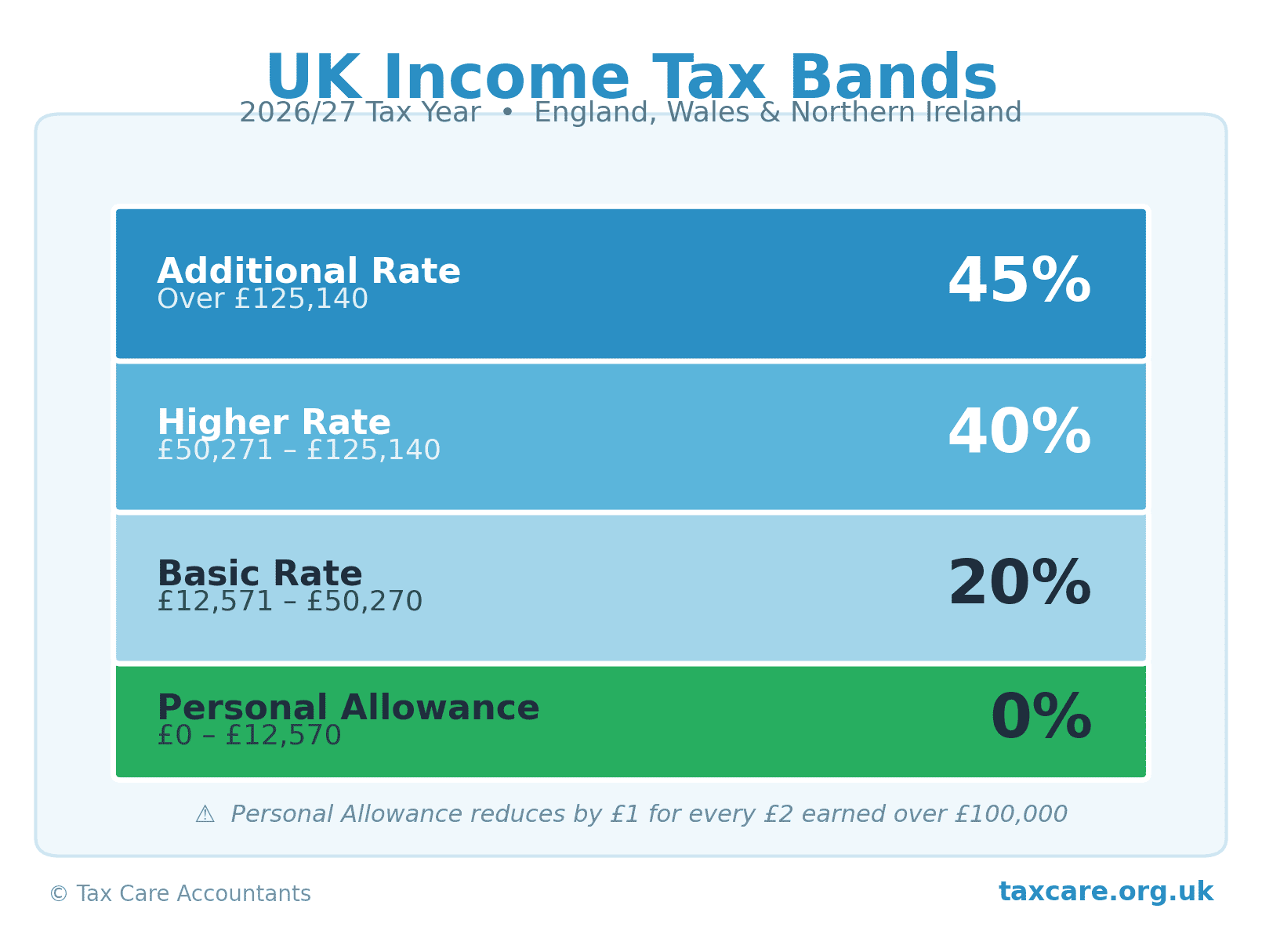
These rates apply in England, Wales and Northern Ireland. Scotland uses a different band structure.
One thing worth knowing about the £100,000 threshold. If your income goes above £100,000, your Personal Allowance starts to taper. You lose £1 of allowance for every £2 you earn above £100,000, and by £125,140 the allowance disappears completely. This creates an effective 60% tax rate on income between those two figures — something that genuinely takes people by surprise when they first see it.
National Insurance for sole traders and freelancers
Class 4 National Insurance is charged on self-employment profits at 6% on the band between £12,570 and £50,270, and at 2% on anything above that.
The government abolished mandatory Class 2 National Insurance for most self-employed people from April 2024. If your profits sit above the small-profits threshold, your Class 2 record is treated as paid automatically. If your profits fall below the threshold and you want that year to count towards your State Pension, you can make voluntary Class 2 contributions at £3.65 per week for 2026/27.
For a fuller explanation of both classes and how they interact, see our guide to National Insurance for the self-employed.
How much tax at common profit levels?
Here is a quick reference showing what three typical profit levels actually cost, based on 2026/27 rates:
Annual Profit | Income Tax | Class 4 NI | Take-home |
£30,000 | £3,486 | £1,046 | £25,468 |
£50,000 | £7,486 | £2,246 | £40,268 |
£70,000 | £15,432 | £2,657 | £51,911 |
These figures assume a sole trader on the standard Personal Allowance with no student loan, dividends or payments on account. For an estimate based on your own figures, use the calculator above.
Who should use this calculator?
This tool is designed for anyone earning self-employment income in the UK:
- Sole traders — whether you are a plumber, builder, consultant or shop owner
- Freelancers — designers, writers, developers, photographers, marketers working for themselves
- Contractors and gig workers who bill clients directly and file through Self Assessment
- People with a side income — anyone earning more than £1,000 a year from self-employment alongside a salaried job
The £1,000 trading allowance is the dividing line. Earn under it and HMRC does not need to know. Go above it and you must register for Self Assessment and file a return. The tax rules for sole traders and freelancers are identical — the job title does not change the calculation.
Can I use this as a Self Assessment tax calculator?
Yes, and that is exactly what it was designed for. Because it works from your actual profit and applies both Income Tax and Class 4 NI, the figure it produces is a realistic preview of what your January bill will look like.
The best way to use it is early in the tax year, then again mid-year once you have a clearer sense of your income. Use the result to work out what to set aside from each payment you receive.
A practical rule of thumb: put 25–30% of every invoice into a separate account as soon as it arrives. If your profits go above £50,270 and you are paying higher-rate tax, that should go up to 35–40%. Do this consistently and the January payment deadline becomes routine rather than stressful.
Not sure whether to file your own return or use an accountant? Our HMRC versus Tax Care comparison walks through the differences.
The three Self Assessment dates that matter most
There is a lot written about Self Assessment deadlines. In practice, most sole traders only need to keep three dates in their heads:
Date | What it means |
5 October | Register with HMRC if this is your first year of self-employment |
31 January | File your online return AND pay your tax bill (both fall on the same day) |
31 July | Second payment on account, if HMRC has asked you to pay towards next year’s bill in advance |
Missing the 31 January deadline triggers an automatic £100 penalty, even when you owe nothing. The longer it goes unfiled after that, the higher the penalties climb. See our guide to late filing penalties to understand exactly how they stack up.
Claiming expenses to reduce your tax bill
Your tax is calculated on profit, not on what comes into your bank account. Every legitimate business expense you claim lowers your taxable profit, and your bill falls with it.
Common deductions that sole traders often underuse include:
- Office supplies, stationery and equipment
- Software subscriptions used for work
- Business travel and mileage
- The business proportion of your mobile phone and broadband
- Accountancy and professional fees
- Business insurance
- A portion of home costs if you regularly work from home
If keeping receipts feels like too much admin, HMRC offers flat-rate simplified expenses that let you claim standard amounts without detailed records. The time you spend tracking legitimate expenses will always be worth it — lower profit means lower tax, and that is entirely legal.