
Do I Need a Bookkeeper If I Use Xero or QuickBooks?
- By Tax Advisor at Tax Care Accountants
- August 18, 2026
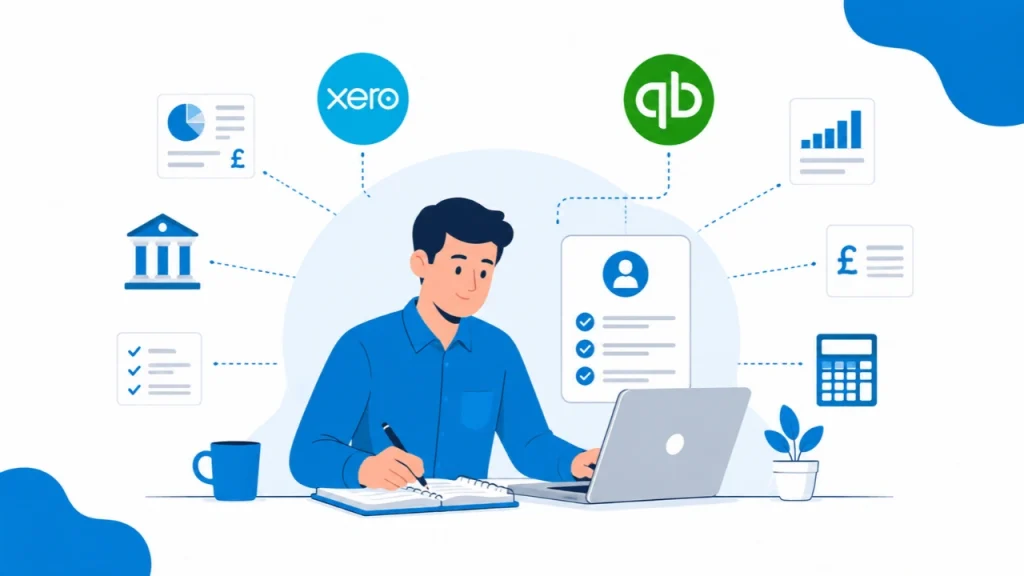
Most UK businesses using Xero or QuickBooks still need a bookkeeper, because the software records transactions but does not check whether they are correct. Xero and QuickBooks automate bank feeds, invoicing and VAT submissions. A bookkeeper handles the judgement work: coding, reconciliation, VAT treatment and spotting errors before they reach your tax return.
If you already pay a monthly software subscription, the fair question is whether you are paying twice for the same job. You are not, but the overlap is smaller than most software marketing suggests. This article sets out where the software stops, where a person is still needed, and how to tell which side of that line your business sits on.
Quick Overview
- Xero and QuickBooks record and submit data. They do not verify that the data is coded correctly.
- Sole traders with low transaction volumes, no VAT registration and no employees can often manage the software alone.
- VAT registration, payroll, stock, foreign currency and limited company status are the usual points at which a bookkeeper becomes worth the cost.
- Bank rules repeat mistakes at scale. One wrong rule can misclassify hundreds of transactions before anyone notices.
- Making Tax Digital for Income Tax applies to sole traders and landlords with qualifying income over £50,000 from 6 April 2026, over £30,000 from April 2027 and over £20,000 from April 2028.
- Correcting poor records at year end usually costs more than maintaining them monthly.
Table of Contents
What Xero and QuickBooks Actually Do for You
Xero and QuickBooks handle the recording, not the reviewing. Both connect to your bank, import transactions, suggest a category based on past behaviour, raise invoices, and file VAT returns directly to HMRC under Making Tax Digital.
The suggestion is the weak point. Software categorises by pattern matching, not by knowing what the payment was actually for.
Task | Handled by software | Still needs a person |
Importing bank transactions | Yes | – |
Suggesting a category | Yes, as an estimate | Confirming the coding is right |
Raising and chasing invoices | Yes | – |
Calculating VAT from coded data | Yes | Checking the coding and VAT scheme |
Filing MTD submissions | Yes | Reviewing figures before submission |
Explaining what the numbers mean | No | Yes |
When You Probably Do Not Need a Bookkeeper
You can usually manage Xero or QuickBooks alone if you are a sole trader with simple, low-volume income and no VAT registration. The software genuinely covers this level of complexity.
That applies when:
- You are a sole trader with roughly 30 to 40 transactions a month and one business bank account.
- You are not VAT registered and you do not run payroll.
- You hold no stock, trade in sterling only, and keep business and personal spending separate.
- You reconcile weekly rather than in an annual catch-up.
- You can read a profit and loss report and recognise when a figure looks wrong.
This position changes quickly. Growth, a first employee or VAT registration all add decisions the software cannot make for you, and quarterly reporting under Making Tax Digital raises the cost of leaving errors uncorrected.
When You Still Need a Bookkeeper Alongside Xero or QuickBooks
You still need a bookkeeper if you are VAT registered, run payroll, hold stock, trade as a limited company, or process more transactions than you can realistically review each week.
You are VAT registered
The software applies whichever VAT treatment you tell it to apply. Domestic reverse charge in construction, zero-rated and exempt supplies, the Flat Rate Scheme and partial exemption are all coding decisions. Xero will file a return built on incorrect coding without objection.
You run a limited company
Director loan accounts, dividends and personal spending through the business account produce most year-end corrections. These entries look ordinary in a bank feed and only cause problems later, in the Corporation Tax computation or the director’s own tax position.
Your transaction volume has outgrown your evenings
Bank rules are the main risk here. A rule set up once will apply the same misclassification to every matching transaction until someone reviews it.
Your accountant keeps sending queries
Repeated year-end questions usually indicate that the underlying records need work. Fixing twelve months of coding retrospectively takes longer, and costs more, than reviewing it monthly.
Bookkeeper vs Accountant vs Software: Who Does What
Software records the data, a bookkeeper keeps it accurate month to month, and an accountant uses it to file your accounts and tax returns.
Software (Xero, QuickBooks, Sage) | Bookkeeper | Accountant | |
Main role | Records and submits | Reviews and corrects | Files and advises |
Typical output | Bank feed, invoices, reports | Reconciled ledgers, VAT checks, payroll runs | Year-end accounts, Corporation Tax, Self Assessment |
Frequency | Continuous | Weekly or monthly | Quarterly and annually |
Judgement involved | None | Coding and treatment | Tax position and planning |
What It Costs to Get Bookkeeping Wrong
Errors in Xero or QuickBooks rarely announce themselves. They surface at year end, or in an HMRC enquiry.
The common consequences are:
- Incorrect VAT recovery. Reclaiming VAT on entertaining, or on a supply that was never standard rated, means correcting the position later and possibly paying interest.
- A distorted tax bill. Overstated profit leads to overpaid Corporation Tax; understated profit leads to an unexpected liability.
- Lost time. Hours spent untangling reconciliation queries are hours not spent on the business.
HMRC expects businesses within Making Tax Digital to keep accurate digital records and submit updates from those records, so unreviewed data now feeds directly into filings during the year rather than only at year end.
How to Decide: A Quick Self-Check
Answer these five questions:
- Are you VAT registered or approaching registration?
- Do you operate payroll, CIS or a limited company structure?
- Do more than 100 transactions pass through your accounts each month?
- Has your accountant raised the same type of query more than once?
- Is your bank reconciliation currently more than a month behind?
Three or more affirmative answers means the software alone is not covering you.
Does Xero replace a bookkeeper?
No. Xero automates data entry and submission, but it does not verify coding, VAT treatment or reconciliation accuracy. Those remain human decisions.
Is QuickBooks enough for a small limited company?
Usually not on its own. Director loans, dividends and expenses require correct treatment that QuickBooks cannot determine from a bank feed alone.
Can a bookkeeper file my VAT return?
Yes. A bookkeeper can prepare and submit MTD-compatible VAT returns on your behalf once authorised as your agent with HMRC.
Do I need both a bookkeeper and an accountant?
Many businesses use both, though some firms, including Tax Care, provide both functions under one arrangement.
How much does a bookkeeper cost in the UK?
Fees depend on transaction volume, VAT status and payroll requirements. Ask for a quote based on your actual monthly volumes rather than a headline rate.
Conclusion
Xero and QuickBooks remove the manual work of bookkeeping. They do not remove the responsibility for accuracy, and that responsibility sits with you regardless of which software you use. If your business is VAT registered, incorporated, or simply busier than it was a year ago, a bookkeeper is reviewing something the software was never designed to check.
Get Your Bookkeeping Reviewed
Send us your existing Xero or QuickBooks file and we will review the coding, reconciliation and VAT treatment, then tell you plainly whether you need ongoing support.
About The Author
John Atkinson
A UK accountant and business finance writer who believes the best tax advice is the kind you actually understand. I help small business owners, freelancers, and growing companies make sense of HMRC deadlines, accounting software, and everything in between. 6 years in practice and part of the team at Tax Care Certified Accountants.
All Posts
Do I Need a Limited Company to Employ People? UK Rules
No, you do not need a limited company to employ people. A sole trader can employ staff by registering with HMRC. Here are the steps, costs and legal duties.
Do I Need a Bookkeeper If I Use Xero or QuickBooks?
Xero and QuickBooks record your transactions but do not check them. Here is when a UK business still needs a bookkeeper, and when the software is enough.
Outsourced Bookkeeping vs In-House: UK Cost Comparison
Compare outsourced bookkeeping vs in-house costs in the UK, including salary, employer NI, pension and software, plus when hiring becomes cheaper.
Self Assessment vs PAYE: What Is the Difference?
Self Assessment vs PAYE explained: how each system collects UK income tax, who uses which, the deadlines that apply, and what happens if you use both.
What Are Payments on Account and How Do They Work?
Payments on account are advance instalments towards your next Self Assessment bill. Learn who pays, how HMRC works out the amount, and how to reduce them.
What Is the SA104 Form?
Understand what the SA104 form is, who must complete it, and how SA104S differs from SA104F. A clear guide for UK partnership partners filing Self Assessment.